

Multicenter Clinical Trials
Multicenter clinical trials are an essential component of modern cardiovascular research. Through collaboration among multiple sites, access to large patient cohorts, and the pooling of clinical expertise, they enable the reliable evaluation of new diagnostic and therapeutic procedures. In addition to participating in national and international studies, physicians and scientists at the CCM ABCD also develop and conduct their own investigator-initiated studies to scientifically evaluate innovative approaches to the prevention, diagnosis, and treatment of cardiovascular diseases.
Ongoing Studies
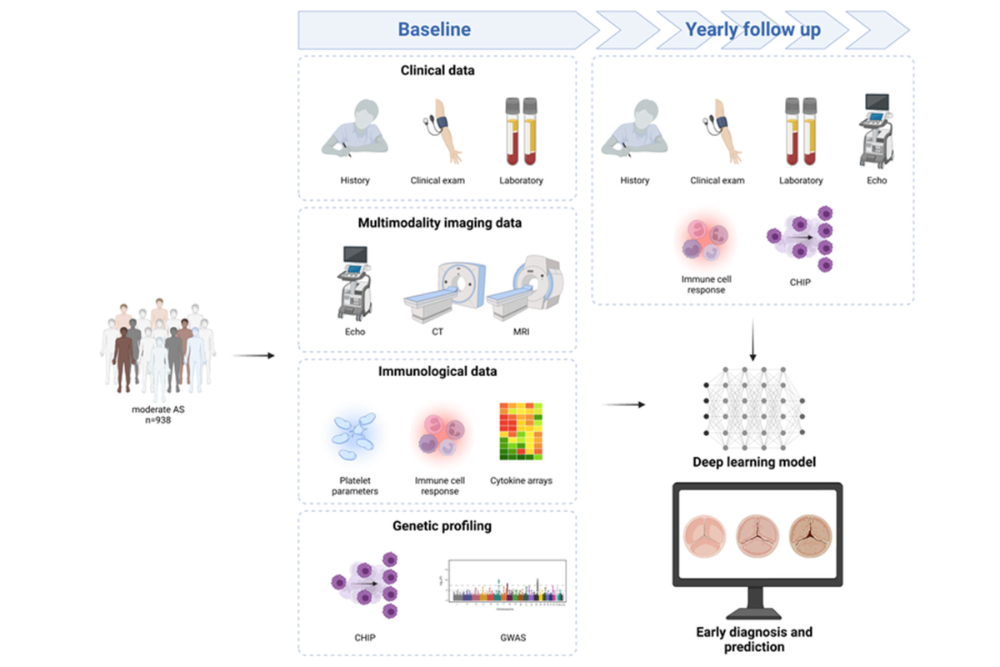
The development of aortic valve stenosis is accompanied by immunological and imaging-based morphological changes in the area of the valve apparatus. Biochemical factors (such as hyperglycemia and hypercholesterolemia) and mechanical stress (such as arterial hypertension) lead to progressive thickening and fibrosis of the valve leaflets, which in turn leads to inflammation, neovascularization, and calcification. These processes occur before hemodynamically significant aortic valve stenosis can be detected, but they are not adequately identified using routine methods. For this reason, another major area of our research focuses on the evaluation of state-of-the-art radiological techniques and cardiac remodeling.
In addition to imaging morphological factors, we also investigate immunological processes for their association with disease progression, as well as the incidence of clonal hematopoiesis of indeterminate potential (CHIP). This refers to the presence of clonal genetic alterations in blood and bone marrow cells, but without evidence of an underlying hematological malignancy. In the past, the incidence of CHIP has already been linked to the occurrence of cardiovascular diseases.
The ultimate goal is to integrate state-of-the-art medical imaging and experimental methodology with innovative technology and artificial intelligence through a systems biology approach to enable the development of deep learning systems. With its extensive dataset, our platform offers a unique opportunity to train a convolutional neural network, create computational models, and thus develop deep learning algorithms—a forward-looking innovation that could revolutionize the diagnosis and, potentially, the treatment of aortic valve stenosis. To this end, as part of the transregional SFB 259 (Project C06), a cohort of 1,000 patients with moderate aortic valve stenosis is being recruited across multiple sites; these patients are being examined using state-of-the-art imaging (echocardiography, cardiac CT, and MRI) as well as the aforementioned immunological, genetic, and other analyses, and they will be followed for 5 years.
Mauri Lab, Zeus Lab, Shamekhi Lab, Lütkens Lab, Franklin Lab – Cologne, Düsseldorf, Bonn
Calcific aortic valve stenosis is a complex, multifactorial disease whose development is facilitated by classic cardiovascular risk factors such as hypertension, hyperlipidemia, diabetes mellitus, and tobacco use. The bicuspid aortic valve, in which the valve has only two cusps, represents a distinct entity. With a prevalence of 1–2%, it is the most common congenital heart anomaly and a major risk factor for the early development of aortic valve stenosis.
Growing evidence indicates that genetic factors play a significant role in the predisposition, clinical manifestation, and progression of aortic valve disease. The underlying genetic architecture is heterogeneous: In addition to rare variants with greater effect sizes—which may be particularly relevant in familial or syndromic forms—common genetic variants, each with a moderate effect size, contribute additively to the risk of disease. Thus, in the majority of cases, aortic valve stenosis is not a monogenic disease but rather the manifestation of a complex polygenic risk structure that affects various biological signaling pathways involved in valve development, calcification, and inflammation.
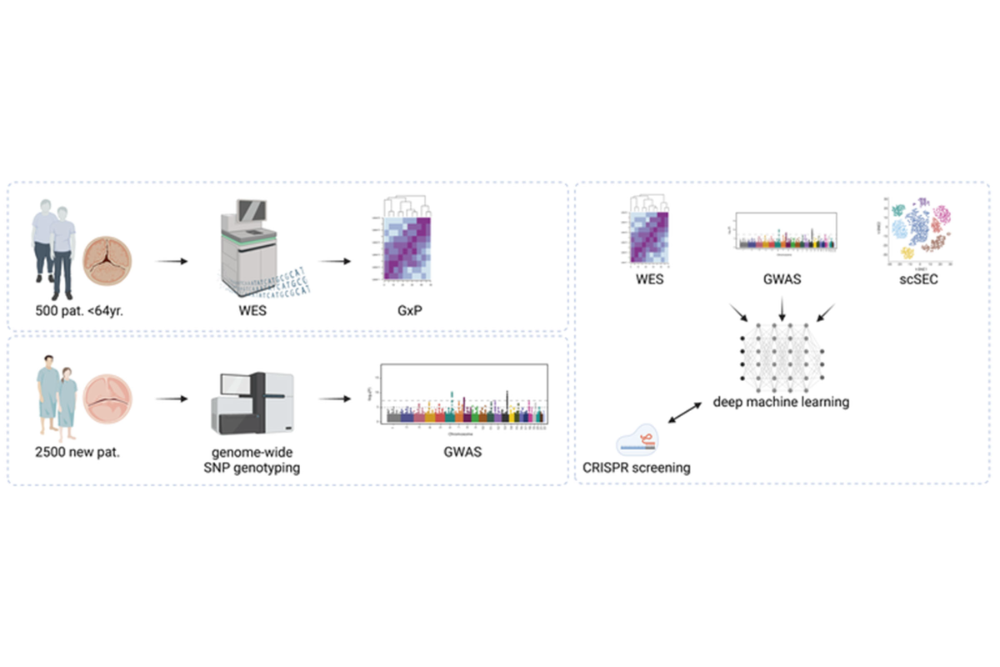
To systematically investigate these underlying mechanisms, the GUARD consortium—Genes Underlying Aortic Valve Disease—was founded (www.guard-net.de). As part of the Collaborative Research Center/Transregio 259 and in close cooperation among the Bonn, Cologne, and Düsseldorf sites, GUARD aims to identify genetic determinants of aortic valve diseases, characterize them functionally, and define their contribution to disease onset and progression.
A central focus is on the bicuspid aortic valve. In a cohort of more than 2,200 patients, GUARD identified a new genetic risk variant (MUC4) on chromosome 3. Functional studies in a zebrafish model showed that alterations in the target gene are associated with delayed heart valve development, thus pointing to a relevant mechanism of valve morphogenesis. Supplementary analyses of rare variants also showed that potentially pathogenic changes in established disease genes such as NOTCH1 or SMAD6 account for only a small proportion of non-syndromic bicuspid aortic valves. This suggests that the majority of sporadic cases are polygenic in origin.
GUARD was also able to identify significant genetic risk factors for aortic valve stenosis. In a genome-wide association study involving more than 18,000 patients and over 430,000 controls, 17 risk loci were identified. Many of these signals were independent of genetic risk factors for coronary heart disease, suggesting a distinct genetic risk structure for aortic valve stenosis. In further international GWAS meta-analyses with significantly larger case numbers, we were able to substantially expand the number of known risk loci.
GUARD is currently conducting large-scale genetic studies on bicuspid and tricuspid aortic valve stenosis. These include sequencing approaches to identify rare risk variants, as well as analyses of polygenic risk scores and disease-modifying variants in longitudinally characterized cohorts. A particular focus is on patients with mild to moderate aortic valve stenosis in order to determine genetic factors contributing to disease progression.
GUARD’s long-term goal is to identify genetic markers for disease risk and progression of aortic valve stenosis. This is intended to lay the foundation for more precise risk stratification and contribute to the development of preventive pharmacological treatment strategies that can influence the course of the disease at an early stage and help avoid invasive valve interventions.
Nöthen Lab, Billmann Lab, Al-Kassou Lab – Bonn
C05-GUARD – Genes Underlying Aortic Valve Disease
Publications
Trenkwalder T, Maj C, Al-Kassou B, et al. Distinct Genetic Risk Profile in Aortic Stenosis Compared With Coronary Artery Disease. JAMA Cardiol. 2025;10(2):145–154. doi:10.1001/jamacardio.2024.3738
Gehlen, J., Stundl, A., Debiec, R., Fontana, F., Krane, M., Sharipova, D., Nelson, C. P., Al-Kassou, B., Giel, A. S., Sinning, J. M., Bruenger, C. M., Zelck, C. F., Koebbe, L. L., Braund, P. S., Webb, T. R., Hetherington, S., Ensminger, S., Fujita, B., Mohamed, S. A., Shrestha, M., … Schumacher, J. (2022). Elucidation of the genetic causes of bicuspid aortic valve disease. Cardiovascular Research, cvac099. Advance online publication. https://doi.org/10.1093/cvr/cvac099
Bruenger, C.M.H., Oeffner, F., Koebbe, L.L. et al. Implications of monogenic bicuspid aortic valve (BAV) forms among sporadic BAV patients. Eur J Hum Genet 33, 1203–1206 (2025). https://doi.org/10.1038/s41431-025-01909-7
Small, A.M., Yang, T.Y., Itoh, S., et al. Genomic and transcriptomic analyses of aortic stenosis enhance therapeutic target discovery and disease prediction. Nat Genet 58, 57–66 (2026). https://doi.org/10.1038/s41588-025-02417-6
Nora Treleaven, Sarah Gillies, Pardis Zamani, Anne-Marie Seguin, Yohan Bossé, Sébastien Thériault, Richard Whitlock, Guillaume Paré, “A Multiomics Review of Aortic Stenosis,” Journal of the Heart Valve Society, (2026).https://doi.org/10.1177/30494826261468625

Cardiogenic shock is a serious complication of acute cardiovascular diseases, particularly acute myocardial infarction. Due to the severely impaired pumping function of the heart, vital organs receive insufficient blood flow, which is associated with a high risk of organ failure and mortality. Catheter-based reopening of the coronary arteries (revascularization), in combination with medical treatment, has been the primary therapy for cardiogenic shock for many years. In addition, some patients require a temporary mechanical circulatory support system to assist the heart’s pumping function. Despite advances in acute care, the mortality rate among affected patients remains at approximately 40–50%.
New clinical findings suggest that some patients with cardiogenic shock may benefit from early escalation to a more powerful heart pump. However, there is currently insufficient scientific evidence to reliably assess the potential benefits and risks of this treatment strategy.
In this context, the investigator-initiated, prospective, multicenter observational study RISE (Rapid Impella Support and Escalation Trial), led scientifically by Prof. Baldus (Cologne), is investigating whether the early upgrade from a microaxial heart pump, which can be placed via the inguinal vessels during a cardiac catheterization procedure, to a more powerful heart pump, that is surgically implanted in the clavicular region, may provide clinical benefits for patients with acute coronary syndrome and cardiogenic shock.
The focus is on whether an early and structured upgrade to a more powerful heart pump in patients with persistent circulatory failure following revascularization is associated with improved hemodynamic stabilization. To this end, clinical courses, circulatory parameters, and safety-related endpoints are systematically recorded.
The aim of the study is to gain insights into optimal strategies for mechanical circulatory support in everyday clinical practice and to further improve the care of patients with severe infarction-related cardiogenic shock.
RISE is supported by a research grant from the manufacturer of Impella heart pumps and is also part of the European research consortium EXIT-CVD. Within this consortium, 42 partner organizations from 17 countries are developing new approaches to the prevention, diagnosis, and treatment of cardiovascular diseases.
Baldus Lab, Heyne – Cologne
Building on the ABCD Endocarditis Registry & Biobank, this multicenter project combines clinical research with experimental basic research. The goal is to rapidly translate findings between the clinical setting and the laboratory.
A central focus is the role of blood coagulation in the development of endocarditis. The characteristic valve deposits (vegetations) consist primarily of a fibrin-platelet clot in which bacteria become embedded and multiply, protected from the immune system. We are investigating how components of the coagulation system contribute to the formation and stabilization of these vegetations and are testing novel antithrombotic strategies as experimental therapeutic approaches.
A second area of focus concerns the long-term consequences of infection-induced inflammation:
To elucidate the mechanisms underlying these processes, we combine translational models with high-resolution molecular analyses of the biosamples registered in our database. These include a single-cell atlas of valve tissue (scRNA-seq) as well as proteomic studies to identify circulating biomarkers for diagnosis, risk assessment, and prognosis evaluation.
Our primary goals are:
- To elucidate the role of the coagulation system (including thrombin and factor XIII) in the formation of valve vegetations and to test antithrombotic therapeutic approaches.
- Understanding infection-driven inflammation.
- Identifying circulating biomarkers using single-cell and vesicular proteomics to improve diagnostics.
Öztürk Lab, Becher Lab, Polzin Lab, Pfister Lab — Bonn, Düsseldorf,
Heart failure is one of the most common and prognostically significant cardiovascular diseases and represents one of the greatest challenges in modern cardiology. Despite significant advances in pharmacological, interventional, and device-based therapies, identifying appropriate treatment strategies for individual patients remains complex. Structural heart diseases, hypertrophic cardiomyopathies, and cardiac amyloidosis are major causes and comorbidities of heart failure and require specialized diagnostic and therapeutic approaches.
The Heart Failure Network Rhineland (HI-Netz Rheinland) is an established scientific network of the University Heart Centers in Bonn, Cologne, and Düsseldorf. The network’s goal is to optimize care for patients with heart failure through close clinical and scientific collaboration. To this end, multicenter registries and prospective studies are used to better characterize disease progression, identify risk groups, and evaluate innovative diagnostic and therapeutic strategies.
The network’s scientific priorities include the REDUCE registry for the study of patients with hypertrophic obstructive cardiomyopathy (HOCM), an amyloidosis registry for the systematic documentation and characterization of cardiac amyloidosis, as well as interventional and pharmacological studies in the field of heart failure. The multicenter EDGEFIRM study is currently underway, while preparations are already underway for the next clinical trial—the FINE-ATTRial—aimed at improving care for patients with ATTR cardiomyopathy. The close collaboration among the participating centers creates ideal conditions for translational research, the rapid implementation of new therapeutic approaches, and continuous improvement in patient care.
Öztürk Lab, Becher Lab, Polzin Lab, Pfister Lab — Bonn, Düsseldorf, Cologne
Completed Studies
In contrast to primary/degenerative mitral regurgitation, in which valve repair or replacement is indicated, the evidence regarding functional mitral regurgitation is unclear. Secondary or functional mitral regurgitation occurs in the context of heart failure, in which left ventricular or left atrial dysfunction leads to dilatation of the left-sided cardiac chambers and consequent annular dilatation. The COAPT study demonstrated, in principle, the superiority of interventional mitral valve reconstruction over medical therapy alone for heart failure in selected patients. However, it remains unclear whether a surgical or interventional approach is superior. The MATTERHORN study (led by Prof. Dr. Stephan Baldus) recruited and randomized 210 patients with functional mitral valve regurgitation who were indicated for treatment of mitral regurgitation to either surgical or interventional therapy. The results of this study were published in August 2024 in the renowned journal *The New England Journal of Medicine*.
Publications
Baldus, S., Doenst, T., Pfister, R., Gummert, J., Kessler, M., Hausleiter, J., Möllmann, H., Rudolph, V., Weber, M., Mahabadi, A. A., & MATTERHORN Investigators. (2024). Transcatheter repair versus mitral valve surgery for secondary mitral regurgitation. New England Journal of Medicine, 391(12), 1105–1115. https://doi.org/10.1056/NEJMoa2408739
Rudolph, F., Geyer, M., Baldus, S., Pfister, R., Kessler, M., Hausleiter, J., Möllmann, H., Mahabadi, A. A., Weber, M., & MATTERHORN Investigators. (2025). Transcatheter repair versus surgery for atrial versus ventricular functional mitral regurgitation: A post hoc analysis of the MATTERHORN trial. Circulation, 151(6), 438–450. https://doi.org/10.1161/CIRCULATIONAHA.124.072648.