

Metabolism in research
Metabolism plays a central role in the development and progression of cardiovascular diseases. A disturbed metabolism, such as in diabetes mellitus or metabolic syndrome, significantly increases the risk of heart disease. In particular, factors such as elevated blood sugar and blood lipid levels as well as insulin resistance have a negative impact on the function of blood vessels and the heart muscle. Our research therefore focuses intensively on how metabolic changes can be addressed preventively and therapeutically in order to reduce the risk of cardiovascular disease and promote heart health.
Ongoing Projects
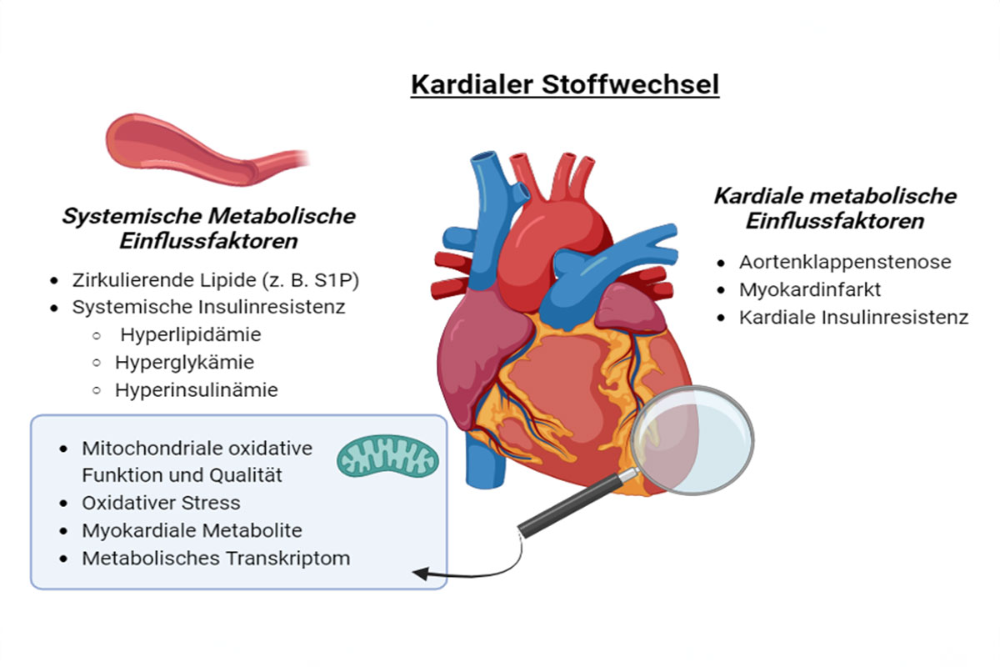
Source: AG Cramer, Scheiber, Spieker, Oehler, Zweck, Polzin, Quast, Düsseldorf
Both systemically circulating and locally produced metabolites play an important role in the pathogenesis of heart valve diseases. A particular focus of our research is on a more detailed investigation of the role of sphingosine-1-phosphate (S1P) in the progression of valve calcification in the context of aortic valve stenosis. On the one hand, we were able to show that progressive valve calcification leads to increased mechanical stress and a significant rise in local S1P production. On the other hand, we were able to elucidate the mechanism of action of this excess S1P via the S1P receptor 2 and the signaling cascade triggered by its activation, which leads to a further worsening of aortic valve stenosis. In current studies, we are investigating the possibilities of pharmacological intervention in this self-reinforcing mechanism to slow or even prevent the progression of the disease in the future, thereby creating an alternative option to surgical valve replacement or repair.
In the clinical picture of aortic valve stenosis, we have also been able to demonstrate changes in cardiac mitochondrial function as early as the initial stages of the disease. We have also demonstrated that different types of cardiac amyloidosis differ in terms of their myocardial mitochondrial function, which ultimately also affects cardiac structure.
In the field of AV valve interventions, we investigated the influence of systemic metabolic factors to better predict mortality following edge-to-edge mitral valve reconstruction. To this end, we utilize and analyze, among other things:
- New MRI/MRS techniques for visualizing myocardial energetics and metabolism
- Mitochondrial respirometry in end-stage heart failure
- The influence of systemic glucose metabolism on myocardial energetics
- Imaging and scoring of systemic factors in AV valve interventions
- Coagulation disorders in (non-)ischemic heart failure
Metabolism in systemic diseases
By combining short- and long-read RNA sequencing, we were able to characterize diabetes-associated transcriptional changes in a key regulator of cardiac metabolism (peroxisome proliferator-activated receptor gamma coactivator 1-alpha, PGC-1α) at the isoform level. Our investigations into the influence of systemic lipids on cardiac function demonstrated the key cardioprotective role of sphingosine-1-phosphate (S1P), particularly when secreted by blood platelets. Ongoing research at the Cardiovascular Research Lab (CVRL) aims to further unravel the complex interplay between cardiac metabolism and platelets in the context of new metabolically active drugs, such as sodium-glucose cotransporter 2 (SGLT2) inhibitors and glucagon-like peptide-1 receptor agonists (GLP1-RA).
As part of our research, we investigate both the effects of systemic metabolites on cardiac function and myocardial energy metabolism and its regulation. For example, we were able to demonstrate in a mouse model that systemic insulin resistance is associated with impaired mitochondrial coupling efficiency in the heart muscle. Furthermore, we have established the methodological framework to comprehensively characterize myocardial metabolism in the human heart under various physiological and pathophysiological conditions, particularly using state-of-the-art cardiac magnetic resonance imaging and spectroscopy (CMR and MRS).
We were thus able to identify reduced myocardial oxidative capacity in individuals with type 2 diabetes mellitus (T2DM). Interestingly, we also found that myocardial mitochondrial oxidative function is already impaired in prediabetes. Using state-of-the-art CMRT, we found that metabolic changes in the myocardium in T2DM are associated with impaired diastolic function while systolic function remains preserved.
The Influence of Lipids on Cardiovascular Diseases
It is well known that other lipids, such as omega-3 fatty acids, also play an important role in the development and progression of cardiovascular diseases. Large randomized trials examining the effect of omega-3 fatty acids on cardiovascular events have so far yielded conflicting results. Furthermore, the exact biological mechanisms underlying these effects have not yet been fully elucidated. Therefore, a more detailed investigation of the underlying mechanism of action has been and remains a key research focus of our research group.
In our studies on omega-3 fatty acids, we have already demonstrated that eicosapentaenoic acid (EPA) inhibits platelet activity—including adhesion, degranulation, and aggregation—in a dose-dependent manner. Experiments in mouse models and molecular analyses suggest that EPA directly competes with arachidonic acid for the enzyme COX-1, which is crucial for the inhibitory effect. In patients with cardiovascular disease, it was also found that switching from EPA to a combination with docosahexaenoic acid (DHA) significantly reduces the inhibitory effect on platelets, which may partially explain the varying study results.
Influence of Lipid Mediators on Ischemic Heart Failure
In acute myocardial infarction (AMI), released lipids such as S1P also play an important role. Antiplatelet drugs are standard in the treatment of AMI but may mask the beneficial effects of activated platelets. In our studies, we were able to show that platelets are a major source of the increase in S1P during an AMI, which is associated with lower cardiovascular mortality and smaller infarct size in STEMI.
Through mechanistic studies in a mouse model, we have shown that the supernatant from activated platelets reduces infarct size in mice. We were also able to demonstrate that this effect is S1P-dependent, as disruptions in S1P production (SphK1), release (Mfsd2b), or signaling (S1P1) abolish this protective effect. The results suggest that some antiplatelet agents (such as tirofiban) preserve the cardioprotective effects, while others (such as cangrelor) impair them, opening up new therapeutic approaches.
Cramer, Spieker, Voß, Zweck Lab, Polzin Lab – Düsseldorf
Publications
Min Zhu, Kun Hua, Huiqing Wang, Zhiyuan Guan, Zexin Tong, Juan Gao, Quanyou Shi, Hu Wang, Shen Yan, Yuhua Liu, Qingqing Shi, Tan Xu, Jiaxing Wang, Tianqi Chang, Yuzhou Xue, Yaobo Zhao, Yiwen Fu, Huiping Zheng, Xinheng Feng, Shaomei Shang, Xiu-Jie Wang, Shi-Qiang Wang, Zhe Zhang, Feng Lan, Changtao Jiang, Xiubin Yang, Lemin Zheng, Ming Xu, “Glycoursodeoxycholic Acid 3-Sulfate Sodium Links Hemodynamics and Bile Acid Metabolism in Aortic Stenosis,” Journal of Advanced Research, 84, (639–655), (2026).https://doi.org/10.1016/j.jare.2025.09.011
Philipp Mourikis et al. Icosapent ethyl reduces arterial thrombosis by inhibiting cyclooxygenase-1–induced platelet reactivity. Sci. Transl. Med. 17, eado0610 (2025). DOI:10.1126/scitranslmed.ado0610
Polzin, A., Dannenberg, L., Benkhoff, M. et al. Revealing concealed cardioprotection by platelet Mfsd2b-released S1P in human and murine myocardial infarction. Nat Commun 14, 2404 (2023). https://doi.org/10.1038/s41467-023-38069-5
Although mortality from cardiovascular diseases has been reduced over the past 50 years, in part due to innovations in medical care, cardiovascular diseases remain the leading cause of death worldwide. In particular, patients with diabetes mellitus and chronic kidney disease (CKD) have a significantly increased cardiovascular risk. To reduce cardiovascular morbidity and mortality, new therapeutic targets must be identified and brought into clinical practice. Data from the past two decades have demonstrated that inflammatory processes play a key role in cardiovascular diseases such as atherosclerosis, myocardial infarction, and heart failure. It has been shown that inflammatory networks between the blood vessels, the heart muscle, the bone marrow, the spleen, the sympathetic nervous system, and the gut significantly influence both the onset and the progression of cardiovascular and cardiometabolic diseases.
Our research group focuses on better understanding the underlying molecular mechanisms of these inflammatory networks within the context of organ crosstalk and on identifying new immunological therapeutic targets based on these findings. We are particularly interested in intestinal mediators (such as the incretin hormones GLP-1, GLP-2, and GIP) and immune cells from the gut (e.g., intraepithelial lymphocytes). Using a bench-to-bedside approach, we aim to validate findings from basic research in clinical studies (registers, biobanks, epidemiological studies, and intervention studies).
Kahles Lab – Aachen
Inflammation in Cardiometabolic Diseases
Publications
Berkan Kurt, Martin Reugels, Kai M Schneider, Jens Spiesshoefer, Andrea Milzi, Alexander Gombert, Christopher B Fordyce, Florian A Wenzl, Neha J Pagidipati, Viviane Rocha, Marat Fudim, Abhinav Sharma, Michael Lehrke, Hiroaki Shimokawa, Giovanna Liuzzo, Lale Tokgozoglu, Filippo Crea, Thomas F Lüscher, Peter Libby, Paul M Ridker, Nikolaus Marx, Carolin V Schneider, Florian Kahles, “C-reactive protein and cardiovascular risk in the general population,” European Heart Journal, Volume 47, Issue 15, April 14, 2026, Pages 1799–1810, https://doi.org/10.1093/eurheartj/ehaf937
Florian A. Wenzl, Peizhi Wang, Florian Kahles, Katharina R. Beck, Evangelos Giannitsis, Slayman Obeid, Francesco Bruno, Xinmin S Li, David Nanchen, Luca Liberale, Maria A Smolle, Victor Schweiger, Roland Klingenberg, Robert Manka, Barbara E Stähli, Christian Templin, Maximilian König, Jinqing Yuan, Mustafa Yildirim, Michael Lehrke, Arnold von Eckardstein, Nikolaus Marx, François Mach, Lorenz Räber, Hugo A. Katus, Elisabeth Steinhagen-Thiessen, Ilja Demuth, John Deanfield, Peter Libby, Stanley L. Hazen, Arash Haghikia, Ulf Landmesser, Fredrik Bäckhed, Thomas F. Lüscher, on behalf of the SPUM-ACS, CLEVER-ACS, Heidelberg II-ACS, and LipidCardio Investigators, “Gut microbiota-derived imidazole propionate predicts cardiometabolic risk in patients with coronary artery disease,” European Heart Journal, 2025; ehaf661, https://doi.org/10.1093/eurheartj/ehaf661
Berkan Kurt, Matthias Rau, Oliver Hartmann, Andreas Bergmann, Martin Reugels, Susanne Just, Florian A. Wenzl, Julia Moellmann, Jens Spießhöfer, Andrea Milzi, Kinan Kneizeh, Kirsten Thiele, Mathias Hohl, Simina-Ramona Selejan, Emiel P.C. van der Vorst, Edgar Dahl, Jörg Schröder, Thomas F. Lüscher, Nikolaus Marx, Michael Lehrke, Florian Kahles,
Adjustment of the SMART risk score by bioactive adrenomedullin enables a more accurate prediction of mortality in patients with ASCVD, Atherosclerosis, Volume 406, 2025, 120220, ISSN 0021-9150, https://doi.org/10.1016/j.atherosclerosis.2025.120220.
Janssen H, Kahles F, Liu D, Monocytes re-enter the bone marrow during fasting and alter the host response to infection, *Immunity*, 2023; 56, 783–796.e7
Kahles, F., Rau, M., Reugels, M. et al. The gut hormone glucose-dependent insulinotropic polypeptide is downregulated in response to myocardial injury. Cardiovasc Diabetol 21, 18 (2022). doi.org/10.1186/s12933-022-01454-3
Innate-like T cells represent a unique group of lymphocytes that combine characteristics of both the innate and adaptive immune systems. Unlike conventional T cells, they can respond rapidly to inflammatory cytokines, metabolic stress, and tissue damage without requiring prior antigen exposure. As a result, they act as early sensors of tissue damage and as regulators of local immune responses.
In recent years, we have demonstrated that the function of mucosa-associated invariant T cells (MAIT cells)—one of the most abundant populations of innate T cells in humans—is tightly regulated by cellular metabolism. Our research has demonstrated that signals from glucose, lipid, and mitochondrial metabolism significantly influence the activation of MAIT cells, their production of inflammatory cytokines, their cytotoxicity, and tissue repair programs. These findings position MAIT cells as key integrators of metabolic and immunological signals and suggest that metabolic changes within diseased tissues can directly influence their function.
In chronic inflammatory diseases such as abdominal aortic aneurysm (AAA), in which profound metabolic and inflammatory changes occur in the vascular wall, understanding how metabolism regulates the responses of MAIT cells could reveal new mechanisms of disease progression and open up new therapeutic targets.
Riffelmacher Lab, Winkels Lab – Cologne
Comorbidities, such as diabetes mellitus and chronic kidney disease (CKD), significantly influence patient prognosis. Diabetes mellitus is one of the major, steadily increasing widespread diseases, and currently about 6 million people in Germany have diabetes. The development of heart failure is a common complication in patients with diabetes mellitus and is associated with a 7- to 10-fold increase in mortality. Another risk factor for thromboembolic events and the development of heart failure—one that has so far been only partially understood—is chronic kidney disease. The hearts of patients with diabetes and/or chronic kidney disease (CKD) exhibit various metabolic and structural changes, although the underlying molecular mechanisms have not yet been fully elucidated. Consequently, there is a lack of specific therapeutic options to improve the prognosis for patients with heart failure and diabetes mellitus or CKD. For this reason, we are dedicated to elucidating the molecular and pathophysiological mechanisms that contribute to cardiovascular morbidity and mortality in patients with diabetes or CKD, both through basic science projects and large-scale clinical studies.
Marx-Schütt Lab - Aachen
The Role of Comorbidities in Cardiovascular Diseases
Publications
Schuett K, Marx N, Lehrke M. The Cardio-Kidney Patient: Epidemiology, Clinical Characteristics, and Therapy. Circ Res. April 14, 2023;132(8):902-914. doi: 10.1161/CIRCRESAHA.122.321748. Epub April 13, 2023. PMID: 37053284; PMCID: PMC10097497.
Katharina Marx-Schütt, David Z. I. Cherney, Joachim Jankowski, Kunihiro Matsushita, Massimo Nardone, Nikolaus Marx, “Cardiovascular Disease in Chronic Kidney Disease,” European Heart Journal, Volume 46, Issue 23, June 14, 2025, Pages 2148–2160, https://doi.org/10.1093/eurheartj/ehaf167
Marx, N., Kern, J.-S., Berger, M., Rizk, M., Marx-Schütt, K., Wolfart, S., Jankowski, V., Lysaja, K., Heinzmann, A., Wolf, M., Reugels, M., & Jankowski, J. (2025). Association of Complement Factor D with Cardiovascular Mortality and Clot Lysis in CKD. Journal of the American Society of Nephrology doi.org/10.1681/ASN.0000000870
Dr. Van der Vorst’s research group focuses on the interaction between lipids and the immune system in the context of cardiovascular disease (CVD). Recently, there has been growing evidence—including from his own research—that the main factors in the development of cardiovascular disease, dyslipidemia, and inflammation, are interdependent and that there is significant crosstalk between these two factors. Drawing on his expertise in high-density lipoproteins (HDL) and chemokine receptors, he will investigate the interaction between these two factors. In addition, the interaction of various other lipids and lipid derivatives with key immunological factors will be examined, which will hopefully identify new therapeutic targets. His research group is also particularly interested in a subgroup of patients that has thus far been somewhat neglected in terms of cardiovascular risk: patients with chronic kidney disease (CKD). It has been clearly demonstrated that CKD patients have a significantly increased incidence of CVD, as evidenced by the fact that nearly half of CKD patients die from CVD rather than from the primary kidney disease itself. Interestingly, this increased CVD risk in CKD patients cannot be fully explained by classic CVD risk factors such as hypertension or dyslipidemia, suggesting the existence of CKD-specific cardiovascular risk factors. The goal is therefore to investigate the role of immune-lipid crosstalk as a pathological mechanism in CKD that could contribute to this increased risk of CVD.
Van der Vorst Lab – Aachen
Immune-Lipid Crosstalk Research Group
Publications
Svenja Adam, Sanne L. Maas, Rosanna Huchzermeier, Leonida Rakateli, Kathrin Abschlag, Mathias Hohl, Liangliang Liao, Matthias Bartneck, Margee Teunissen, Kristiaan Wouters, Donato Santovito, Joachim Jankowski, Erik A.L. Biessen, Emiel P.C. van der Vorst, “The calcium-sensing receptor (CaSR) in adipocytes contributes to sex differences in susceptibility to high-fat diet-induced obesity and atherosclerosis,”
eBioMedicine, Volume 107, 2024, 105293, ISSN 2352-3964, doi.org/10.1016/j.ebiom.2024.105293.
Döring Y, van der Vorst EPC, Yan Y, Neideck C, Blanchet X, Jansen Y, Kemmerich M, Bayasgalan S, Peters LJF, Hristov M, Bidzhekov K, Yin C, Zhang X, Leberzammer J, Li Y, Park I, Kral M, Nitz K, Parma L, Gencer S, Habenicht A, Faussner A, Teupser D, Monaco C, Holdt L, Megens RTA, Atzler D, Santovito D, von Hundelshausen P, Weber C. Identification of a non-canonical chemokine-receptor pathway that suppresses regulatory T cells to drive atherosclerosis. Nat Cardiovasc Res. Feb 1, 2024;3:221-242. doi: 10.1038/s44161-023-00413-9. Published online Jan. 22, 2024. PMID: 39044999; PMCID: PMC7616283.
Anette Christ, Sanne L. Maas, Han Jin, Chang Lu, Bart Legein, Erwin Wijnands, Lieve Temmerman, Jeroen Otten, Aaron Isaacs, Martin Zenke, Monika Stoll, Erik A.L. Biessen, Emiel P.C. van der Vorst, In situ lipid-loading activates peripheral dendritic cell subsets characterized by cellular ROS accumulation but compromises their capacity to prime naïve T cells, Free Radical Biology and Medicine, Volume 210, 2024, Pages 406–415, ISSN 0891-5849, doi.org/10.1016/j.freeradbiomed.2023.11.044.
Our research group focuses on metabolic changes associated with cardiovascular diseases. Of great importance is the interaction between cardiovascular diseases and conditions such as diabetes and chronic kidney disease, as well as inflammatory processes. We aim to gain a molecular understanding of the underlying disease processes at the cellular level and are interested in the connections between cell growth, substrate utilization, and mitochondrial function. Our goal is to better understand existing therapies and identify new therapeutic targets. We are particularly interested in the effects of incretin hormones such as GLP-1 and GIP, as well as SGLT2 inhibition, on the cardiovascular system.
Möllmann Lab – Aachen
Publications
Moellmann, J., Glandien, K., Klinkhammer, B.M., Wollenhaupt, J., Noels, H., Jankowski, J., Lebherz, C., Boor, P., Lehrke, M., and Marx, N. (2025), “Development of a Mouse Model of Uremic Cardiomyopathy: Investigating the Impact of Chronic Kidney Disease on Cardiac Function and Signaling Pathways.” The FASEB Journal, 39: e70639. https://doi.org/10.1096/fj.202500281R
Julia Moellmann, Katja Krueger, Dickson W.L. Wong, Barbara M. Klinkhammer, Eva M. Buhl, Jonas Dehairs, Johan V. Swinnen, Heidi Noels, Joachim Jankowski, Corinna Lebherz, Peter Boor, Nikolaus Marx, Michael Lehrke, “2,8-Dihydroxyadenine-induced nephropathy causes hexosylceramide accumulation with increased mTOR signaling, reduced levels of protective SirT3 expression, and impaired renal mitochondrial function,” Biochimica et Biophysica Acta (BBA) - Molecular Basis of Disease, Volume 1870, Issue 1, 2024, 166825, ISSN 0925-4439, doi.org/10.1016/j.bbadis.2023.166825
Our research group focuses on the complex relationships between metabolic regulation and cardiovascular health. We place particular emphasis on the hormones amylin and the incretin hormones, which play a central role in regulating blood glucose levels. We are investigating how these hormones influence glucose homeostasis and how they may contribute to the development or prevention of diabetes mellitus and cardiovascular diseases. Amylin is a hormone produced by the pancreas; we are investigating its physiological function and pathological effects to better understand its role in glucose homeostasis and thereby model its influence on pathological processes. In particular, we aim to investigate the interaction between amylin and incretin hormones. We analyze the mechanisms through which metabolic diseases lead to damage to blood vessels and the heart, particularly the development and progression of atherosclerosis and heart failure in people with diabetes. Our work lays the groundwork for the development of new treatment strategies, particularly through the targeted use of hormonal agents or substitutes to prevent cardiovascular complications in diabetes. In our research, we combine molecular biological methods, preclinical models, and clinical data to gain a deeper understanding of the pathophysiological relationships between hormonal action, metabolic diseases, and cardiovascular health.
Gorgels Lab - Aachen
Hormones in Cardiovascular Diseases - University Hospital Aachen
Publications
Viviana Casagrande, Luca Panarello, Alessio Lepri, Andrea Quatrana, Chiara Internò, Lorenzo Antonetti, Elena Bonanno, Ilaria Cicalini, Damiana Pieragostino, Andrea Gorgels, Vincenzo De Laurenzi, Claudia Goettsch, Marina Cardellini, Massimo Federici, Rossella Menghini, “Effect of 3-hydroxyisobutyrate in vivo administration on cardiometabolic disease in an ApoE-/- mouse model,” Pharmacological Research, Volume 220, 2025, 107943, ISSN 1043-6618, https://doi.org/10.1016/j.phrs.2025.107943.
Jonas Heyn, Andrea Gorgels, Nicolas Hense, Alexander Gombert, Eva Miriam Buhl, Lisa Stark, Sonja Vondenhoff, Joel Simon, Heidi Noels, Nikolaus Marx, Claudia Goettsch,
GRP75 inhibition attenuates arterial calcification, Atherosclerosis, Volume 409, 2025, 119243, ISSN 0021-9150, https://doi.org/10.1016/j.atherosclerosis.2025.119243.
Dzhanaev, R., Hasberg, C., Gorgels, A., Schmitz, C., Winkler, C.F., Malyaran, H., Gräber, S., Gentier, A., Jaminon, A., Agten, S., Hackeng, T., Akbulut, A.C., Schurgers, L., Mottaghy, F.M., Goettsch, C., Jahnen-Dechent, W. (2023). Application of the mineral-binding protein fetuin-A for the detection of calcified lesions. Theranostics, 13(2), 659–672. doi.org/10.7150/thno.78773.
The interaction between the heart and lungs plays a central role in numerous diseases. In particular, elevated pressure in the pulmonary circulation (“pulmonary hypertension”) is a significant factor in morbidity and mortality, regardless of its cause. Approximately 1% of the general population has elevated pressure in the pulmonary circulation of any etiology. This typically leads to chronic right ventricular overload, ranging from right ventricular insufficiency to right heart failure.
The research group is intensively engaged in studying the pathobiological basis, as well as the treatment and classification, of pulmonary hypertension. Through translational research approaches, pathomechanisms, therapeutic targets, and corresponding signaling pathways are investigated both in human patients and in established mouse models. The basic research focus is on vascular remodeling processes and peptide growth factors, as well as the receptor tyrosine kinases they activate and other kinase-dependent signaling pathways. In addition, the pathomechanisms of adaptive and maladaptive right ventricular hypertrophy are also a key area of interest. With regard to vascular remodeling processes, the basic research focus is on the evaluation of PI-3-kinase-dependent signaling pathways. Here, PI-3-kinase alpha has been identified as a central target molecule in the context of pulmonary arterial hypertension. In group 2 pulmonary hypertension (in the context of left heart disease), relevant therapeutic targets have been identified in various compartments (left heart, pulmonary circulation, right heart) in the setting of heart failure with preserved ejection fraction and resulting pulmonary hypertension. The clinical portfolio includes Phase II, III, and IV studies on various forms of pulmonary hypertension, taking into account different treatment strategies.
Rosenkranz Lab – Cologne
Publications
Humbert M, McLaughlin VV, Badesch DB, Ghofrani HA, Gibbs JSR, Gomberg-Maitland M, Preston IR, Souza R, Waxman AB, Moles VM, Savale L, Vizza CD, Rosenkranz S, Shi Y, Miller B, Mackenzie HS, Kim SS, Loureiro MJ, Patel MJ, Koglin J, Cornell AG, Hoeper MM; ZENITH Trial Investigators. Sotatercept in patients with pulmonary arterial hypertension at high risk for death. N Engl J Med. May 29, 2025;392(20):1987-2000. doi: 10.1056/NEJMoa2415160. PMID: 40167274.
Zierden M, Berghausen EM, Gnatzy-Feik L, Millarg C, Picard FSR, Kiljan M, Geißen S, Polykratis A, Zimmermann L, Nies R, Pasparakis M, Baldus S, Valasarajan C, Pullamsetti SS, Winkels H, Vantler M, Rosenkranz S. Hematopoietic PI3Kδ deficiency aggravates murine atherosclerosis through impairment of Tregs. JCI Insight. Nov 22, 2024;9(22):e155626. doi: 10.1172/jci.insight.155626. PMID: 39378110. PMCID: PMC11601942.
Gerhardt F, Fiessler E, Olsson KM, Kayser MZ, Kovacs G, Gall H, Ghofrani HA, Badr Eslam R, Lang IM, Benjamin N, Grünig E, Halank M, Lange TJ, Ulrich S, Leuchte H, Held M, Klose H, Ewert R, Wilkens H, Pizarro C, Skowasch D, Wissmüller M, Hellmich M, Olschewski H, Hoeper MM, Rosenkranz S. Positive vasoreactivity testing in pulmonary arterial hypertension: therapeutic consequences, treatment patterns, and outcomes in the modern management era. Circulation. May 14, 2024;149(20):1549-1564. doi: 10.1161/CIRCULATIONAHA.122.063821. PMID: 38606558.
Berghausen EM, Janssen W, Vantler M, Gnatzy-Feik LL, Krause M, Behringer A, Joseph C, Zierden M, ten Freyhaus H, Klinke A, Baldus S, Alcazar MA, Savai R, Pullamsetti SS, Wong DWL, Peter Boor P, Zhao JJ, Schermuly RT, Rosenkranz S. Disrupted PI3K subunit p110alpha signaling protects against pulmonary hypertension and reverses established disease in rodents. J Clin Invest. Oct 1, 2021;131(19):e136939. doi: 10.1172/JCI136939. PMCID: PMC8483754.
Rosenkranz S, Feldman J, McLaughlin VV, Rischard F, Lange TJ, White RJ, Peacock AJ, Gerhardt F, Ebrahimi R, Brooks G, Satler C, Frantz RP; ARROW Study Group. Selonsertib in adults with pulmonary arterial hypertension (ARROW): a randomized, double-blind, placebo-controlled, phase 2 trial. Lancet Respir Med. Jan 2022;10(1):35-46. doi: 10.1016/S2213-2600(21)00032-1.